S/4HANA 2021 end of maintenance: plan your upgrade now
S/4HANA 2021 end of maintenance comes at the end of 2026: what stops for GST and TDS, 2023 vs 2025, RISE terms and a 90-day upgrade plan.
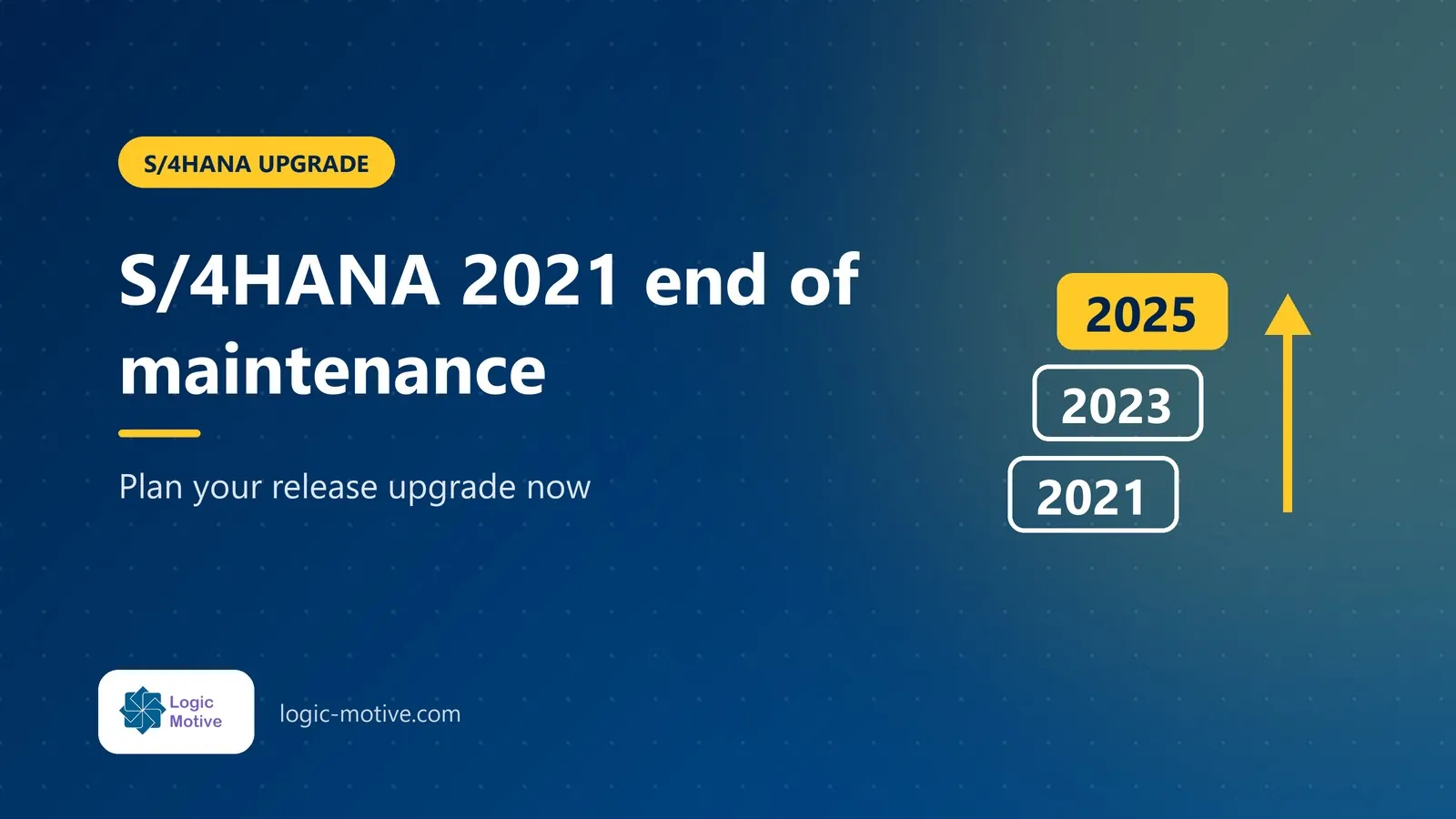
The S/4HANA 2021 end of maintenance comes at the end of 2026. From January 2027 the release is in customer-specific maintenance, SAP's most limited support phase. The system keeps running. What stops is the flow of new support packages and legal changes from SAP.
For an Indian manufacturer the legal changes matter most: GST, e-invoicing and TDS rules keep changing.
If you have not yet run a sandbox upgrade, plan on production moving in 2027.
This guide covers what ends, release dates, RISE terms, choosing between S/4HANA 2023 and 2025, what drives S/4HANA technical upgrade effort, and a 90-day plan. Still on ECC? Start with our guide to SAP ECC end of support in 2027.
S/4HANA 2021 end of maintenance: what ends in December 2026
SAP's public maintenance timelines of November 2024 and February 2026 show S/4HANA 2021 going straight from mainstream into customer-specific maintenance, with no extended maintenance. SAP's last extended maintenance offer for S/4HANA covered releases 1709 to 1909 and ended with 2025 (SAP News, September 2022). An SAP presentation from 2023 lists the restrictions:
- No delivery of legal changes or new support packages.
- No guarantee of technology updates, such as new kernels for new database or operating system versions.
- No support for new interfaces.
- Fixes for known problems only; solving new problems may carry a fee.
- No service level agreements.
The full terms are in SAP Note 52505 (login required).
SAP's Security Notes page says that, as a rule, a release entering customer-specific maintenance is considered for high-priority security notes only in its first 12 months. These are notes rated 7.0 or higher on the CVSS severity scale. Even then, only support packages shipped in the previous 24 months are covered (SAP Note 3053725). Check your current stack's ship date today.
The India angle: legal changes stop
SAP delivers legal changes inside feature and support package stacks (Getting Started With SAP S/4HANA 2025), and customer-specific maintenance excludes them. Indian rules keep moving: the Income-tax Act, 2025 came into force on 1 April 2026.
From 2027, any statutory change that needs ABAP code, such as a GST return format, an e-invoice schema, an e-way bill rule or a new TDS form, must be built and tested by your own team or support provider. The India legal-change notes your team imported in 2026 show the size of that workload.
S/4HANA release strategy: maintenance dates by release
From S/4HANA 2023 onwards, SAP ships a new release every two years, and each release gets seven years of mainstream maintenance instead of five. SAP says at least one S/4HANA release will be in maintenance until 2040 (SAP News, September 2022). Each release receives three feature package stacks (FPS), then support package stacks (SPS) carrying corrections and legal changes (Getting Started With SAP S/4HANA 2025).
- 1909. Mainstream maintenance ends: End of 2024. Status, October 2026: Optional extended maintenance ran to the end of 2025; now customer-specific
- 2020. Mainstream maintenance ends: End of 2025. Status, October 2026: In customer-specific maintenance
- 2021. Mainstream maintenance ends: End of 2026. Status, October 2026: Customer-specific maintenance from January 2027
- 2022. Mainstream maintenance ends: End of 2027. Status, October 2026: Upgrade during 2027; start planning now
- 2023. Mainstream maintenance ends: End of 2030. Status, October 2026: First seven-year release; in its SPS phase
- 2025. Mainstream maintenance ends: End of 2032. Status, October 2026: Current release; FPS02 published in October 2026
Sources: the SAP timelines and SAP News above. They show years; exact dates are in SAP's Product Availability Matrix (PAM, login required).
RISE with SAP and Private Edition: who does the upgrade
SAP S/4HANA Cloud Private Edition (now also sold as SAP Cloud ERP Private) follows the on-premise release cycle, so the dates are the same. SAP Learning says Private Edition customers must install at least one upgrade every seven years to stay in mainstream maintenance and may request one upgrade a year. That matches the seven-year maintenance of S/4HANA 2023 and later; 2021 had five. SAP runs the technical upgrade; planning, preparation and testing are yours or your partner's.
SAP's Roles and Responsibilities document (July 2026) adds detail:
- Standard services include orchestrating and executing the technical upgrade and running SAP Readiness Check for upgrades.
- Planning and coordination, pre- and post-upgrade Basis tasks, and SPDD/SPAU adjustment (re-applying your changes to SAP objects after the upgrade) are "Packaged Services": you pay extra or do them yourself. Your own objects in SPDD/SPAU still need your team's decisions.
- The standard upgrade task cannot be used for rehearsals or dry runs.
- The Zero Downtime Option is a separately charged service. Checking SAP PI/PO, the middleware many interfaces run on, after an upgrade is your task.
SAP's Private Edition upgrade guide makes you confirm that each add-on has a released version for the target; otherwise SAP cannot process the upgrade.
For RISE systems entering customer-specific maintenance, SAP sells SAP S/4HANA Cloud Safekeeper. It gives maintenance broadly aligned with extended maintenance, including security fixes, plus upgrade services and a temporary sandbox. It runs for at most 27 months from the start of customer-specific maintenance, and functional testing and changes to your own add-ons and modifications are excluded.
SAP provides the ordering document on request between 18 and 6 months before customer-specific maintenance starts, and may not deliver on time if you sign less than three months before. For 2021, which enters customer-specific maintenance in January 2027, both points (around July and October 2026) have passed. If you have not ordered, ask SAP in writing whether Safekeeper is still open to you and from when. Eligible releases are listed in SAP Note 3424346.
Choosing the target: S/4HANA 2023 or 2025
- Mainstream maintenance until. S/4HANA 2023: End of 2030. S/4HANA 2025: End of 2032
- Current phase. S/4HANA 2023: SPS only: corrections and legal changes. S/4HANA 2025: FPS02 published; a third FPS is planned
- Testing SAP expects for later updates. S/4HANA 2023: SPS: regression testing recommended. S/4HANA 2025: FPS: regression testing plus functional testing of new features
- Upgrade again by. S/4HANA 2023: End of 2030. S/4HANA 2025: End of 2032
An S/4HANA 2023 upgrade means a lighter test load later; 2025 buys two more years of mainstream maintenance.
Either way, target the latest FPS or SPS. Two checks usually decide:
- Add-ons and partner solutions. Maintenance Planner blocks the upgrade if an add-on has no released version for the target (SAP Notes 2214409 and 2861669). Get written confirmation of supported releases from your GST Suvidha Provider (GSP) connector, tax, banking and plant-integration vendors.
- India localisation. Ask your tax team to compare the India pages in SAP Help for each candidate release. For example, SAP Help for 2025 says the Cloud Integration flows of the legacy India e-invoice solution lose support from the 2027 FPS0 release (SAP Help).
If both pass, the longer horizon of 2025 usually wins. Choose 2023 when a critical add-on or vendor is not ready for 2025.
How an S/4HANA technical upgrade works
SAP's Upgrade Guide for SAP S/4HANA 2025 sets this sequence:
- SAP Readiness Check for SAP S/4HANA upgrades. Recommended and included in standard support. It covers simplification items, custom code, add-ons, interfaces and Fiori apps.
- Maintenance Planner. Mandatory. It checks add-ons, business functions and industry solutions, and produces the stack.xml file.
- Simplification Item-Check. Mandatory. The Software Update Manager runs it at the start and again before downtime, when any error with return code 8 or higher stops the run. SAP warns against ignoring yellow messages; its example is custom table appends that are not retained by default, so their data is lost.
- Custom code checks in the ABAP Test Cockpit (ATC), SAP's code-check tool, or the Custom Code Migration app against the target release, as in our S/4HANA custom code assessment guide.
- Software Update Manager (SUM 2.0) performs the upgrade, including modification adjustment in SPDD and SPAU.
- Follow-on work. Silent data migration jobs, Fiori follow-on steps, SU25 (which brings SAP's new default authorisation values into your roles), and obsolete data clean-up.
SAP's Data Transition Validation tool (standard licence) compares business reports before and after; pick the reports with business users and auditors.
What drives the effort
- Modifications and manual note corrections. SAP's Private Edition guide warns about dictionary objects created by manual SAP Note corrections. If the target stack lacks those corrections, the SUM run can delete them, and data is lost unless you recreate them in SPDD. SAP gives larger legal changes, such as India's GST, as an example (SAP Note 2513585). The same applies on-premise. List these objects before the sandbox run.
- SAP HANA and operating system. Check minimum revisions in the PAM and the release information note (SAP Note 3493301 for 2025). Check how long your SAP HANA 2.0 support package stack stays in maintenance in SAP Note 2378962 (login required).
- Fiori. SAP recommends the embedded front-end server (SAP Learning). A standalone hub must move to the matching front-end server (FES 2025 for S/4HANA 2025).
- Interfaces. IDocs, RFCs, bank and GSP connections, e-way bill, plant systems and SAP BTP flows each need an owner and a test.
- Compatibility packs. SAP's February 2026 briefing shows that, outside a cloud subscription, use rights for most compatibility scope items ended on 31 May 2026. Transportation (LE-TRA), customer service (CS) and PP-PI run to 2030. Under a RISE subscription, use rights run to the end of 2030, and Safekeeper does not extend them. Check usage with the report in SAP Note 2399707 and ask SAP what options apply.
- Downtime. A standard SUM run needs technical downtime. SAP's Zero Downtime Option upgrades S/4HANA 2020 or higher without it, but needs an SAP-trained expert, a mandatory sandbox test cycle and extra planning. SAP Note 2351294 lists other downtime measures.
- Testing. Regression cycles for month-end close, GST return data, e-invoice IRN generation and cancellation, e-way bills, TDS, payment runs and MRP.
After go-live: re-check logging and security
SAP applies its secure-by-default settings, such as the Security Audit Log, table logging for business-critical tables and the HANA audit log, automatically. SAP's post lists new installations, system copies and conversions; it does not mention upgrades. It also says SAP changed the kernel defaults of some security parameters, so the newer kernel installed with a release upgrade can change values you never set explicitly.
After cutover, compare the rec/client parameter that switches table logging on, table log flags, Security Audit Log configuration (RSAU_CONFIG) and HANA audit settings with your pre-upgrade baseline, and keep the evidence. Our SAP ITGC and audit trail checklist has the control list.
If you cannot finish before the end of 2026
- Record the risk in one page for the CFO and audit committee: what is lost, interim controls and the dated upgrade plan.
- Close gaps before year-end. Apply outstanding India legal-change notes and, on RISE, ask SAP about Safekeeper. If your support package stack is older than 24 months, weigh moving to the latest 2021 stack so SAP's security window still covers you in 2027.
- Pick the window. For most Indian companies the financial year ends on 31 March (Companies Act, 2013, section 2(41)). Keep the cutover clear of the March close and audit fieldwork; agree dates with your auditor.
- Name who builds legal changes. While on 2021, someone must track and build statutory changes; if that is your support provider, put it in the contract (see our guide to SAP AMS transition).
- On S/4HANA 2022? Mainstream maintenance ends at the end of 2027. Start the readiness work now, budget the upgrade early in FY 2027-28, and aim to go live well before December 2027.
A 90-day plan
Weeks 1 to 2: collect facts. Release, stack and ship date; add-ons; HANA revision and OS; Fiori deployment; interfaces with owners; compatibility pack usage; RISE terms.
Weeks 3 to 6: analyse. Run Readiness Check, the Simplification Item-Check and ATC for 2023 and 2025. Get vendor confirmations in writing. List modifications and manual note corrections.
Weeks 7 to 10: run a sandbox upgrade on a recent copy of production (on RISE, scope and order this run separately). Measure SUM runtime, SPDD/SPAU volume and errors, and decide whether the Zero Downtime Option justifies its overhead.
Weeks 11 to 13: decide the target release and stack, cutover window, test scope, team and budget. Finish the risk note and brief your statutory auditor.
Decision checklist
- Is every add-on released for the target release and stack?
- Does each India statutory process (GST returns, e-invoice, e-way bill, TDS) have a test case and an owner?
- Who builds legal changes while we are in customer-specific maintenance?
- Who checks and evidences audit-trail settings after go-live?
- Who runs the upgrade: our Basis team, SAP under RISE, or an outside firm? For an independent second opinion, see our SAP support and AMS services.
Frequently asked questions
Will S/4HANA 2021 stop working in January 2027?
No. The system keeps running and SAP still accepts incidents. The release moves into customer-specific maintenance: no new support packages or legal changes, no guaranteed technology updates, and fixes for known problems only, with a possible fee for new ones.
Can we buy extended maintenance for S/4HANA 2021?
No. SAP's public maintenance timelines show no extended maintenance for S/4HANA 2020 or later; the last offer, for releases 1709 to 1909, ended in 2025. RISE with SAP customers can ask about SAP S/4HANA Cloud Safekeeper, a separately priced service that gives maintenance broadly aligned with extended maintenance for up to 27 months. For 2021, SAP's ordering window has largely passed, so ask SAP in writing.
Does RISE with SAP include the upgrade?
Partly. SAP executes the technical upgrade as a standard service, and Private Edition customers may request one upgrade a year. Planning, Basis pre- and post-work and SPDD/SPAU adjustment are paid packaged services or your job; rehearsals need separate scope; testing is yours. Check your RISE contract.
Get an S/4HANA upgrade decision review
What we review:
- your current release and FPS or SPS;
- your add-ons and their compatibility with the candidate releases;
- custom code findings for the target release;
- your interfaces and Fiori set-up.
What you receive. A target-release recommendation, a list of the effort drivers specific to your system, and a test scope outline that includes GST, e-invoicing and TDS scenarios. It builds on the results of SAP's own Readiness Check and does not replace it.
What you provide. System and release details, your add-on list, and ATC results or system access, as agreed.
LogicMotive is an independent SAP consultancy and sells no licences, so the recommendation is not tied to a licence sale. Ask for an S/4HANA upgrade decision review.
Sources
- SAP Maintenance Strategy: Maintenance Timelines (public chart, November 2024), SAP SE, assets.dm.ux.sap.com (accessed Oct 2026)
- Compatibility Packs in SAP S/4HANA: A bridge into the new world (Arne Schmidthals, SAP SE, 4 February 2026; marked PUBLIC; includes the "Maintenance Timelines" chart and the compatibility scope decision tree), SAP user group webinar, assets.dm.ux.sap.com (accessed Oct 2026)
- New SAP S/4HANA Release and Maintenance Strategy to Deliver Greater Innovation and Flexibility (15 September 2022), SAP News Center, news.sap.com (accessed Oct 2026)
- No Customer Left Behind: Supporting each Customer's choice on their Innovation Path (2023 presentation), SAP SE, hosted by ASUG, blog.asug.com (accessed Oct 2026)
- SAP Security Notes & News, SAP Support Portal, support.sap.com (accessed Oct 2026)
- Getting Started With SAP S/4HANA 2025 (document version 3.0, 7 October 2026), SAP Help Portal, help.sap.com (accessed Oct 2026)
- Income-tax Act, 2025, Section 1: Short title, extent and commencement (section 1(3)), Income Tax Department, incometaxindia.gov.in (accessed Oct 2026)
- Navigating Release Upgrades (course: Implementing SAP S/4HANA Cloud Private Edition), SAP Learning, learning.sap.com (accessed Oct 2026)
- SAP S4HANA Cloud, private edition, SAP ERP, PCE, and SAP Business Data Cloud: Roles and Responsibilities (v.07.2026), SAP Global Cloud Operations, assets.cdn.sap.com (accessed Oct 2026)
- Upgrade Guide for SAP S/4HANA Cloud Private Edition 2025 (document version 3.0, 7 October 2026), SAP Help Portal, help.sap.com (accessed Oct 2026)
- SAP S/4HANA Cloud Safekeeper: Cloud Service Specifications (v.2-2026), SAP, assets.cdn.sap.com (accessed Oct 2026)
- Upgrade Guide for SAP S/4HANA 2023 (document version 7.0, 5 August 2026), SAP Help Portal, help.sap.com (accessed Oct 2026)
- Upgrade Guide for SAP S/4HANA 2025 (document version 3.0, 7 October 2026), SAP Help Portal, help.sap.com (accessed Oct 2026)
- Electronic Invoices (Legacy), India, SAP S/4HANA 2025 FPS02, SAP Help Portal, help.sap.com (accessed Oct 2026)
- Software Update Manager (SUM), SAP Support Portal, support.sap.com (accessed Oct 2026)
- Understanding SAP Fiori Launchpad Deployment Options, SAP Learning, learning.sap.com (accessed Oct 2026)
- Zero Downtime Option for SAP S/4HANA, SAP Support Portal, support.sap.com (accessed Oct 2026)
- The story resumes – Secure By Default for SAP S/4HANA 2021 (Björn Brencher, SAP), SAP Community, community.sap.com (accessed Oct 2026)
- The Companies Act, 2013 (section 2(41), definition of "financial year"), India Code, indiacode.nic.in (accessed Oct 2026)